The Ultimate Guide to LED Grow Lights | Everything You Need to Know Before You Buy (2026)
The Ultimate Guide to LED Grow Lights |
Everything You Need to Know Before You Buy (2026)
There was a time when growing indoors meant accepting three unavoidable facts.
First, your grow room was going to be hot. Very hot.
Second, your electricity meter would spin with the enthusiasm of a fruit machine in a seaside arcade.
Third, every year or so you'd be buying another HPS bulb because the old one had quietly become less effective.
Thankfully, those days are largely behind us.
Modern LED grow lights have transformed indoor gardening. They run cooler, use significantly less electricity and deliver more usable light to your plants than ever before. Better still, they last for years without the constant bulb changes, ballast maintenance and temperature battles that older lighting systems demanded.
Whether you're growing herbs on a kitchen shelf, keeping houseplants healthy through the darker winter months or building a fully equipped indoor garden, choosing the right grow light will have a greater impact on your results than almost any other piece of equipment.
And that's where things become confusing.
Spend half an hour browsing the internet and you'll quickly find yourself buried beneath technical jargon.
PPFD.
PAR.
PPF.
Micromoles.
Samsung LM301H EVO diodes.
Bridgelux LEDs.
Light maps.
Efficiency ratings.
Before long, buying a grow light starts to feel less like shopping and more like revising for an engineering exam.
This guide is here to change that.
We'll explain what actually matters, ignore the marketing fog and help you choose an LED grow light that's right for your space, your plants and your budget.
If you're already comparing different models, take a look at our full range of LED Grow Lights. We stock everything from compact propagation fixtures to professional bar-style systems from Spider Farmer, Mars Hydro, Lumatek and Omega.

What Is an LED Grow Light?
At its simplest, an LED grow light is an artificial sun.
Its job isn't to make your grow room look attractive. It exists for one reason only: to provide the light energy plants need for photosynthesis.
Without enough light, plants struggle.
Growth slows.
Leaves become pale.
Stems stretch in search of brighter conditions.
Flowering and fruit production become disappointing.
Even the best nutrients in the world can't compensate for poor lighting. You can feed a plant perfectly, maintain the correct pH and keep the roots in excellent condition, but if the leaves aren't receiving enough usable light, the plant simply doesn't have the energy to perform.
That's why experienced growers often say that lighting is the engine of an indoor garden. Everything else supports it.
Modern full-spectrum LED Grow Lights have become remarkably sophisticated. Rather than producing just one colour of light, they combine carefully selected wavelengths to mimic natural daylight. This allows a single fixture to support healthy growth from seedling through to flowering and fruit production.
Unlike the old "blurple" LEDs, today's premium fixtures produce a clean white light that's far more pleasant to work under. Spotting pests, checking leaf colour and inspecting plant health becomes much easier when everything isn't bathed in an eerie purple glow.
If you're starting from scratch, you'll usually get the best results by pairing your light with a properly sized Grow Tent and suitable Ventilation Kit. Light drives growth, but stable temperature, humidity and airflow keep that growth healthy.

Why Have LED Grow Lights Become So Popular?
The answer comes down to efficiency.
Plants don't care how much electricity your light consumes.
They care how much useful light reaches their leaves.
That's an important distinction.
Imagine buying two kettles.
Both consume 3,000 watts, but one boils water in half the time.
Which one is better?
The same principle applies to grow lights.
A quality LED converts a much greater proportion of electricity into usable light instead of heat. That means more photons reach your plants while less energy is wasted warming the room.
The result is a long list of practical benefits.
Lower Electricity Bills
Electricity is one of the biggest ongoing costs of indoor gardening.
Modern LED fixtures can reduce energy consumption significantly compared with older HID lighting systems, particularly when replacing HPS installations.
The savings become more noticeable when you consider that lighting often runs for many hours each day. A difference of 200 watts might not sound dramatic, but over several months of continuous use it soon adds up.
Over the course of several years, those savings can make a premium LED Grow Light light considerably cheaper to own than it first appears.
When comparing lights, don't just look at the purchase price. Consider the total cost of ownership:
-
Electricity consumption.
-
Expected lifespan.
-
Heat management requirements.
-
Replacement parts.
-
Warranty.
-
Light output for the power used.
A £300 light that runs efficiently for years can easily work out better value than a £150 light that needs replacing sooner and costs more to operate.
Less Heat
Heat is often the hidden challenge in indoor gardening.
Too much of it and you'll need larger extraction fans, more ventilation and potentially even air conditioning during warmer months.
LED technology produces far less radiant heat than traditional HPS lighting, making it much easier to maintain stable growing conditions.
That means happier plants and fewer environmental headaches.
It can also mean quieter equipment. If your lighting isn't turning the tent into a tropical sauna, you may not need to run your extraction system flat out all day.
If you're building a complete grow room, our ranges of Grow Tents, Inline Fans and Ventilation Kits can help create a stable environment around your lighting.
Longer Lifespan
An HPS bulb gradually loses intensity as it ages.
Many growers replaced them every year to maintain consistent performance.
Quality LED Grow Lights are different.
Most premium fixtures are rated for around 50,000 hours or more.
Run your lights for 18 hours a day and that's well over seven years of use before reaching their rated lifespan.
For many home growers, that's close to a decade without worrying about replacing the light source.
Of course, not every LED is built to the same standard. This is one reason we recommend buying from established manufacturers with proper warranties, published specifications and a track record of reliable fixtures.
LED vs HPS: Has LED Really Won?
Twenty years ago, asking whether LED was better than HPS would have started a lively debate.
Today, the conversation is rather shorter.
That's because LED technology has matured enormously.
Here's a straightforward comparison.
|
Feature |
LED Grow Lights |
HPS Lighting |
|
Electricity Consumption |
Lower |
Higher |
|
Heat Output |
Low |
High |
|
Bulb Changes |
No |
Yes |
|
Light Distribution |
Excellent |
Central hotspot |
|
Dimming |
Usually built in |
Additional equipment often required |
|
Lifespan |
50,000+ hours |
Around 10,000 hours |
|
Running Costs |
Lower |
Higher |
|
Spectrum Control |
Broad, full-spectrum options |
More limited |
|
Ease of Use |
Plug in, hang and adjust |
Lamp, ballast and reflector setup |
This isn't to suggest HPS suddenly became a poor technology.
Commercial growers achieved excellent results with it for decades.
But technology moves on.
Just as most of us wouldn't swap a modern smartphone for a pager, few indoor growers are keen to return to lighting systems that consume more electricity, produce more heat and require more maintenance.
For most growers today, LED is the sensible choice unless there's a very specific reason to use another technology.
Why Full Spectrum Lighting Matters
Walk outside on a bright summer's day and take a look at the sunlight.
It appears white.
In reality, it's made up of a huge range of different wavelengths.
Plants have evolved under that light for millions of years.
Modern full-spectrum LED grow lights aim to recreate those conditions indoors.
Instead of relying on just red and blue LEDs, premium fixtures combine white LEDs with carefully balanced deep red wavelengths to produce light that's suitable throughout the plant's entire lifecycle.
The result is healthier growth, improved plant structure and lighting that's much more comfortable to work beneath.
You'll also notice another advantage.
Plants look like plants.
Leaves appear green rather than grey.
You can identify nutrient deficiencies more easily.
Pests become easier to spot before they become a serious problem.
It may sound like a small detail, but anyone who's spent an afternoon trying to inspect leaves beneath an old purple LED panel will appreciate the difference.
What Does "Full Spectrum" Actually Mean?
The phrase gets used a lot, so it's worth clearing up what it means.
A full-spectrum LED grow light doesn't necessarily reproduce every wavelength found in natural sunlight with perfect accuracy. Instead, it provides a broad range of wavelengths that plants can use effectively for photosynthesis and development.
Most quality fixtures include:
-
Blue wavelengths for compact vegetative growth.
-
Green wavelengths that help create a more natural working light.
-
Red wavelengths for flowering and fruit production.
-
Deep red wavelengths to support plant development and flowering responses.
The key point is balance.
A light overloaded with one colour may produce decent results in a narrow set of circumstances, but a well-designed full-spectrum fixture gives plants the broad, useful output they need throughout their life cycle.
This is why we generally recommend full-spectrum fixtures for home growers. They are easier to use, easier to inspect plants under and versatile enough to support a wide range of crops.
Why White LED Grow Lights Are Easier to Work With
Early LED grow lights often used a mixture of red and blue diodes.
Technically, they could provide useful light to plants.
Practically, they made the grow room look like a low-budget nightclub.
Modern white-spectrum LEDs changed that.
A natural-looking light makes it much easier to:
-
Spot pests.
-
Identify nutrient deficiencies.
-
Check leaf colour.
-
Inspect new growth.
-
Take photographs.
-
Work comfortably around the plants for longer periods.
It also makes the entire growing space feel less clinical and more like a proper garden.
Choosing a Brand: What Actually Matters?
Once you've decided on LED, the next question is usually brand.
The market is crowded, and not every manufacturer publishes the same level of information.
When comparing brands, look for:
-
Published power draw.
-
PPF output.
-
Efficiency rating in µmol/J.
-
Coverage recommendations.
-
Warranty length.
-
Build quality.
-
Dimming control.
-
Driver quality.
-
Customer support.
-
Realistic light maps rather than exaggerated coverage claims.
At ledgrowstore.co.uk, the main lighting brands we recommend for different needs are:
Spider Farmer
Spider Farmer is a strong choice for growers looking for reliable performance and good value.
The range covers everything from compact beginner lights to larger bar-style fixtures for serious indoor gardens.
Best for:
-
First-time growers.
-
Small and medium grow tents.
-
Growers who want a proven brand without paying luxury prices.
Browse the full amazing Spider Farmer range here.
Mars Hydro
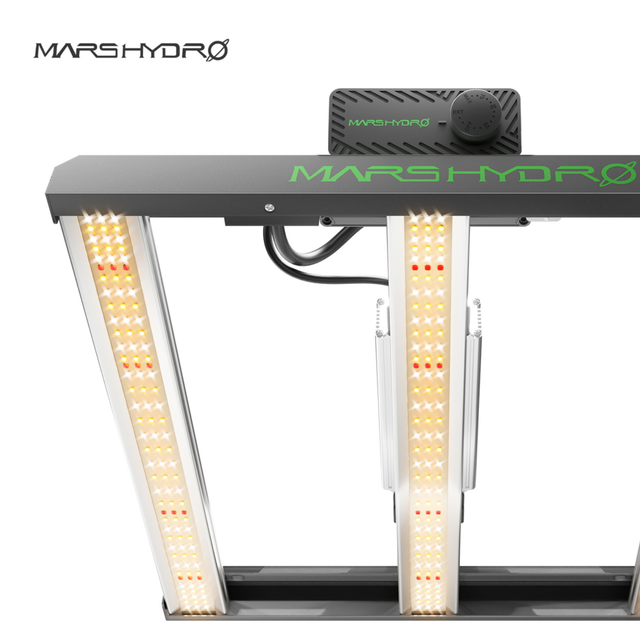
Mars Hydro has built a reputation for offering powerful fixtures with excellent coverage and useful smart-control features on selected models.
Their bar-style lights are particularly popular for larger tents.
Best for:
-
Medium and large grow spaces.
-
Growers who want strong coverage.
-
Users interested in app or controller-based lighting control.
Browse the full Mars Hydro LED Grow Light range.
Lumatek
Lumatek sits at the premium end of the market.
Their fixtures are designed for growers who want exceptional efficiency, build quality and long-term reliability.
Best for:
-
Serious hobby growers.
-
Commercial-style setups.
-
Anyone prioritising efficiency and premium components.
Browse the full Lumatek LED Grow Light range here.
Omega
Omega offers dependable LED fixtures with straightforward controls and solid performance.
They're often a good option for growers who want a reliable light without unnecessary complexity.
Best for:
-
Budget-conscious growers.
-
Simple, dependable setups.
-
Replacing older HPS systems.
Browse the full Omega LED Grow Light range.
The Most Important Buying Rule
Ignore the biggest number on the box.
Look at the size of your growing area.
A 600-watt light isn't automatically better than a 300-watt light.
If you're growing in a 60 × 60 cm tent, a 600-watt fixture may be excessive. It could create unnecessary heat, consume more electricity than needed and make environmental control more difficult.
Likewise, trying to light a 120 × 120 cm tent with a 100-watt board is unlikely to produce the results you're hoping for.
The right light is the one that matches the area you're actually trying to illuminate.
That's where coverage, PPFD and efficiency become far more useful than raw wattage alone.
0 Comments
There are no comments for this article. Be the first one to leave a message!